In brief
Huaqiangbei, in Shenzhen's Futian district, is a cluster of electronics markets for components and finished products. Settle BIS compliance before price, buy samples before volume and visit the factory for private-label orders.
Shenzhen and Huaqiangbei
Shenzhen borders Hong Kong and is one of China's main centres for electronics design and manufacturing. Its best-known trading district is Huaqiangbei, in Futian district, a cluster of multi-storey electronics markets along Huaqiang North Road. The district serves buyers of mobile accessories, consumer gadgets, smart devices and electronic components, and it sits close to a large manufacturing base in Shenzhen and neighbouring Dongguan.
For Indian traders in mobile accessories and consumer electronics, Huaqiangbei is often the first stop. It shows a wide range in one place and gives a quick sense of prices, product trends and the suppliers worth a follow-up visit.
How the district is laid out
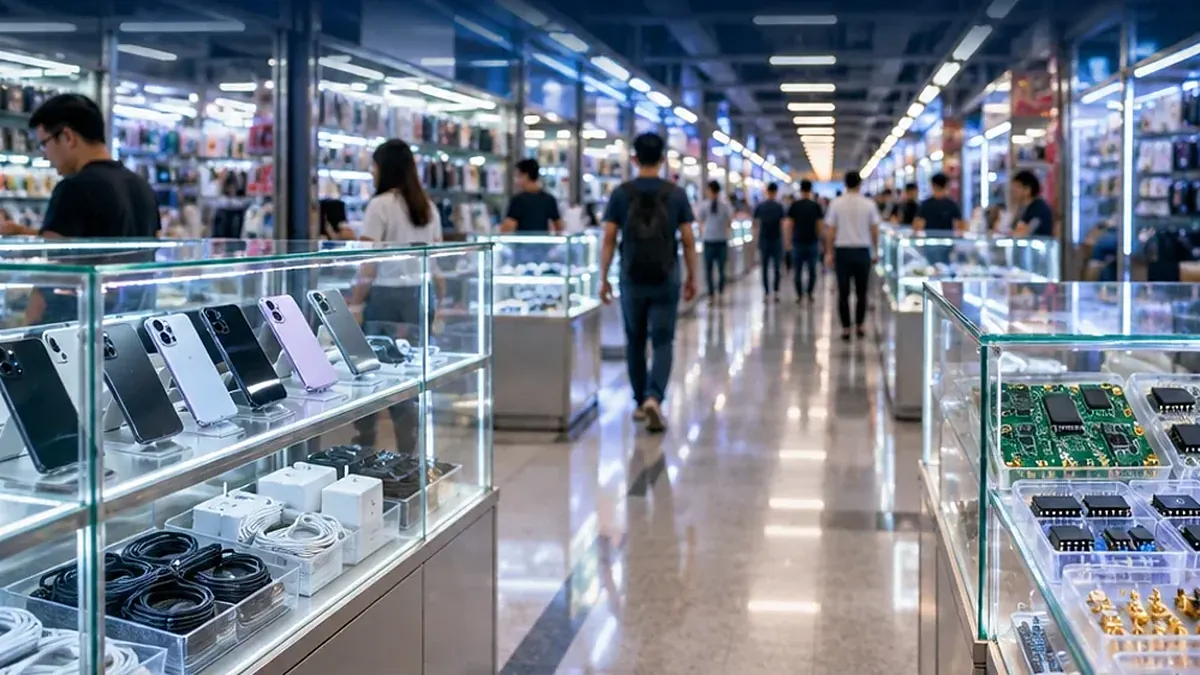
Huaqiangbei is a walkable district of large market buildings, each with many small booths over several floors. The buildings broadly divide into two types.
- Components markets sell integrated circuits, connectors, LEDs, displays, batteries, cables and other parts. These suit manufacturers, repair businesses and product developers.
- Finished products markets sell mobile phone accessories, chargers, cables, earphones, speakers, power banks, smart watches, security cameras and other gadgets. These suit traders, distributors and retailers.
Floors within a building are often grouped by product. Booths in the same building may sell nearly identical products at different prices, so it pays to compare several before negotiating. The district is served by metro stations on Huaqiang Road, and most buildings are a short walk apart.
Common categories for Indian buyers
| Category | Typical products | Points to check |
|---|---|---|
| Mobile accessories | Cases, screen guards, cables, chargers, holders | Material, charging standard, packaging, branding |
| Audio | Earbuds, headphones, speakers | Battery capacity, Bluetooth version, warranty terms |
| Power | Power banks, adapters, chargers | Cell quality, safety certification, actual capacity |
| Smart devices | Smart watches, trackers, cameras, home devices | App support, language settings, data compliance |
| Components | LEDs, ICs, displays, connectors, batteries | Part numbers, origin, datasheets, minimum quantities |
Compliance for the Indian market
Compliance decides whether an electronics order can be sold in India, so it should be settled before price. Many electronic and IT products sold in India must be registered with the Bureau of Indian Standards under the Compulsory Registration Scheme. The registration is product-specific and manufacturer-specific, so a product from an unregistered factory cannot be imported under another factory's registration.
- Ask the supplier whether the product is already registered with BIS for India, and request the registration details.
- If it is not registered, ask whether the factory will register it, who pays for testing, and how long it takes.
- Check whether wireless products need additional approvals, and confirm labelling requirements with your customs broker.
- Keep test reports and certificates with the purchase documents.
Rules change, and the list of products covered is updated from time to time. Confirm the current position with your customs broker or a compliance consultant before placing an order.
Market seller or factory
Many sellers in Huaqiangbei are traders who source from several factories. Others are factory showrooms. Both are useful. A trader can supply mixed products in small quantities; a factory offers better control over specification, packaging and branding at larger volumes.
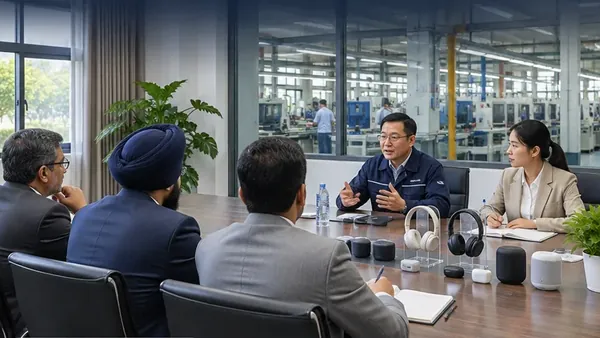
Ask each seller directly whether they manufacture the product, where the factory is, and whether a visit can be arranged. For private-label orders, a factory visit is strongly advisable. On our group tours, factory visits are matched to the group's trade, and Shenzhen and Dongguan have a large base of electronics factories.
Samples, quality and negotiation
- Buy samples before volume. Test them in India for performance and durability before committing to an order.
- Specify in writing. Battery capacity, cable gauge, charging protocol and materials should be stated in the proforma invoice.
- Ask about warranty and defects. Agree how defective units will be handled and replaced.
- Check packaging. Retail packaging, barcodes and Indian labelling requirements should be agreed before production.
- Use a translator for detailed discussions. Technical terms are easily misunderstood across languages.
Practical points
- Most buildings open from mid-morning to early evening. Arrive early on weekdays for quieter aisles.
- Many sellers prefer WeChat for follow-up. Set up the app before travelling; see our note on payments and apps in China.
- Carry a list of the product codes or photographs of the items you already sell, to compare like with like.
- Do not pay deposits to personal accounts. Use a proforma invoice and the seller's company account.
Fitting Shenzhen into a group trip
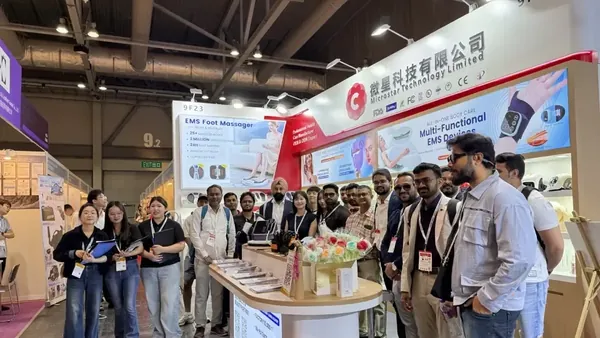
Shenzhen is reachable from Guangzhou by road or high-speed train. A five-day South China programme can include a Shenzhen day for the electronics market and a second day for factory visits. Hong Kong is next to Shenzhen, and the HKTDC electronics fairs and other sourcing shows are held there in spring and autumn. Hong Kong is a separate entry with its own rules, and returning to the mainland needs a visa that allows re-entry, so plan the visa route before adding it.
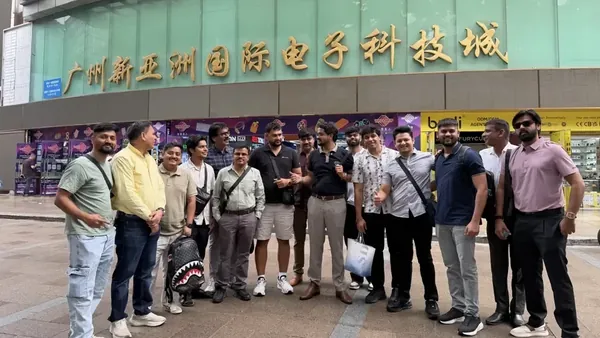
Our January 2027 tour follows this pattern, with Foshan, Guangzhou and Shenzhen over five days.
Questions
What can Indian traders buy in Huaqiangbei?
Mobile accessories, chargers, cables, audio products, power banks, smart devices and security cameras in the finished products markets, and integrated circuits, LEDs, displays, connectors and batteries in the components markets.
Do electronics bought in China need BIS registration for India?
Many electronic and IT products sold in India must be registered under the BIS Compulsory Registration Scheme, and the registration is specific to the product and the manufacturer. Confirm the current position before ordering.
How do you get from Guangzhou to Shenzhen?
By road or by high-speed train. A five-day South China programme can include a Shenzhen market day and a factory day.
Plan a private China business tour for your group of 10 or more.
Plan a group tour